
The Show-Up Gap: 2026 Event Attendance Study
Organizers invest a lot in marketing, speakers and logistics, but getting registered guests to actually show up is still the hard part. We surveyed 1,996 event invitees across 938 events in 62 countries to measure the gap between saying yes and showing up.

miss events they said yes to, at least sometimes
as likely to miss events regularly without saving them to a calendar (26% vs. 5%)
won’t save the date at all without a dedicated calendar button
of people adding an evening event miss agreed events at least sometimes
Six things we learned about who shows up
Quantitative benchmarks on attendee scheduling habits and self-reported attendance patterns.
Four in ten miss agreed events
In our 2026 survey of 1,996 event invitees, 41% said they miss events they said yes to at least sometimes, while 9% miss them often or very often.
One in seven fails to capture details
Without a dedicated calendar button, 14% of invitees do not record the date, relying purely on memory or doing nothing at all.
The fivefold attendance gap
People who do not save an event to their calendar are five times as likely to regularly miss events (26% often or very often) as people who save it manually (5%).
Evening events face higher drop-off
Invitees saving evening sessions report missing agreed events far more often than those saving morning sessions (50% vs. 33%).
Webinars struggle relative to conferences
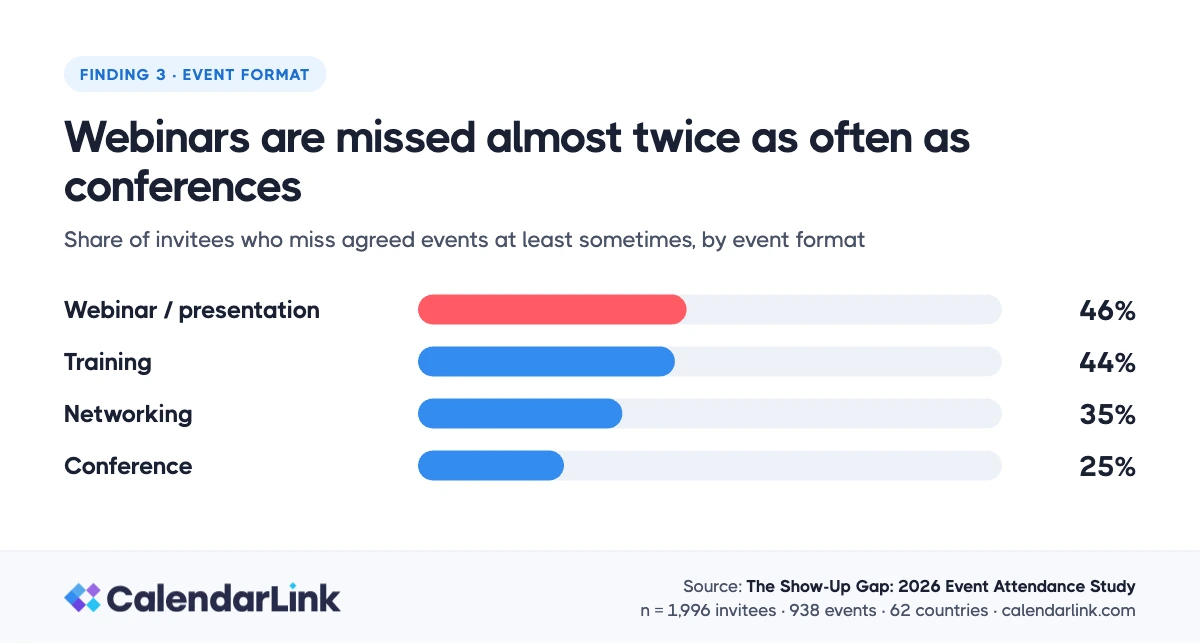
People adding webinars report missing agreed events at nearly double the rate of people adding conferences (46% vs. 25%).
Regional variations exist
People adding events in the US report missing agreed events at 46%, compared to 33% among invitees in Europe.
Four in ten people miss events they said yes to
A substantial share of registrants fail to turn positive intentions into a live check-in on event day. In our survey of 1,996 event invitees, 41% acknowledged missing events they had accepted at least sometimes.
Many planners assume that an RSVP guarantees an attendee’s arrival. But commitments made days or weeks in advance often decay as competing priorities emerge. Only 19% of respondents never miss an event they accepted. The remaining 81% experience some degree of drop-off, with 9% missing events on a regular basis (7% often, 2% very often).
For teams reviewing how to measure event success, raw registration figures tell only part of the story. A high volume of positive RSVPs can hide significant drop-off if registrants don’t anchor the event in their everyday scheduling tools.

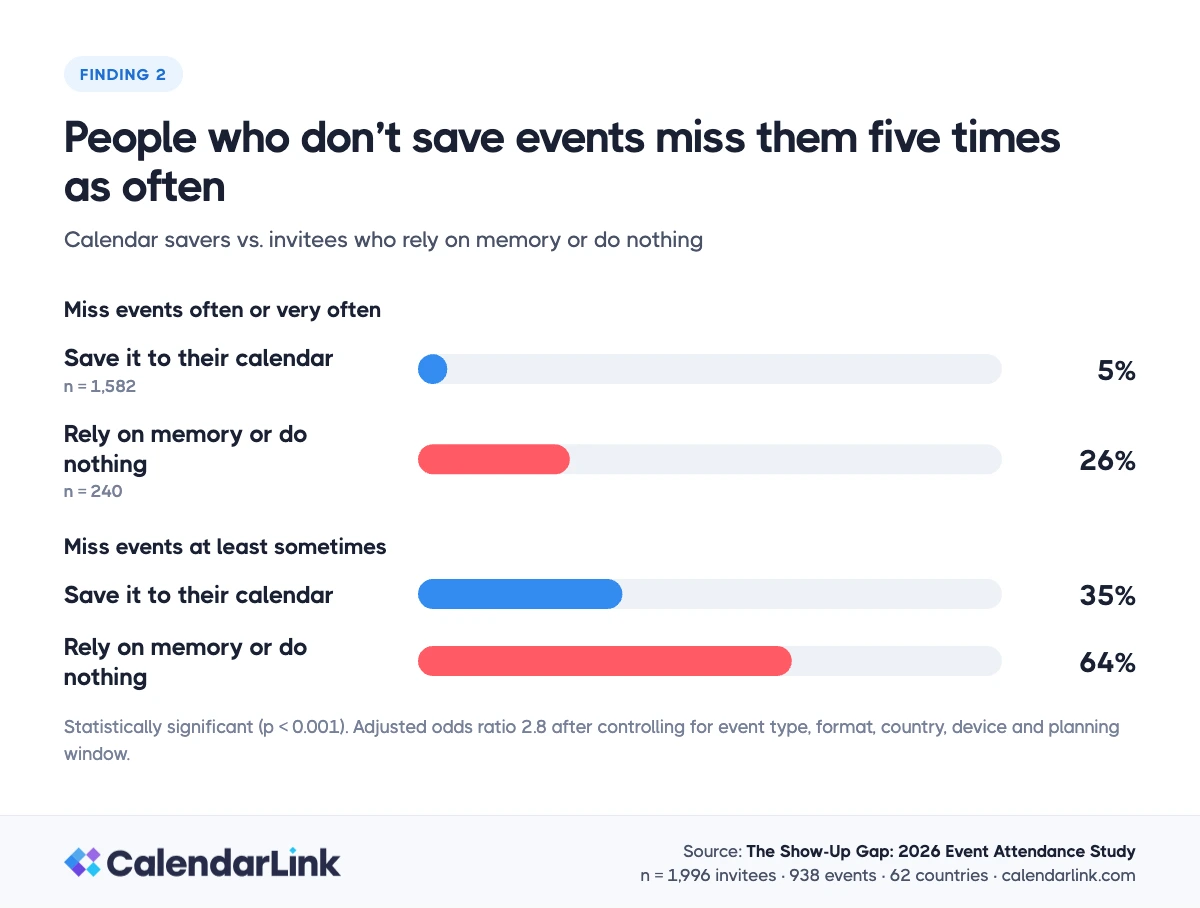
People who don’t save events miss them five times as often
Capturing an event on a digital schedule is closely linked to whether an invitee actually attends. People who do not save events are five times as likely to regularly miss them as people who save them.
We compared invitees based on what they would do if no quick-add button existed (n = 1,886 across comparable groups). Among respondents who would manually add the event to their calendar (n = 1,582), only 5% reported missing events often or very often, and 35% at least sometimes.
Among respondents who would rely on memory or do nothing (n = 240), 26% reported missing events often or very often, and 64% at least sometimes.
When and what: the events people miss most
Share of people who miss agreed events at least sometimes. Evening sessions, online presentations and US-based invitees show the highest self-reported drop-off.



Time of day
33% of morning attendees report missing agreed events at least sometimes. That climbs to 43% in the afternoon and peaks at 50% for evening sessions, when work and family responsibilities easily push an unanchored commitment aside.
Event format
Webinars and presentations are missed most (46%), followed by training sessions (44%). Networking events drop to 35% and conferences show the lowest rate at 25%. Conferences usually take travel or money, which makes the commitment firmer than a one-click webinar sign-up.
Region
Among people adding events in the US (n = 742), 46% report missing events they said yes to at least sometimes. Australia and New Zealand show similar habits at 44%, while invitees in Europe report 33%.
Session length
Sessions up to 1 hour were missed by 46%, 2 to 4 hours by 32% and half-day to full-day programs by 19%. Treat this as an indication: after statistical controls, duration did not keep independent significance.
What didn’t make a difference
Honest research reports null results too. These factors showed no statistically significant difference:
Practical takeaways to close the gap
Our research measures a relationship, not cause and effect. Still, the data points to clear improvements for event planners.
Put the calendar button on the confirmation page
This catches the 14% of invitees who won’t capture the date without a dedicated button. Don’t leave it to a confirmation email that may land in spam: secure the hold while interest is highest.
Give evening events a reminder
With 50% of evening invitees missing agreed events at least sometimes, an event in the personal calendar with a reminder 15 to 30 minutes before start keeps it from being pushed aside.
Make webinars stick
Webinar registrants miss sessions at 46%. Pair your RSVP flow with an immediate calendar save so passive interest turns into attendance.
Skip the raw .ics download
Downloading .ics files adds friction, especially on phones. Universal links that open Google Calendar, Apple Calendar, Outlook and Yahoo directly make saving effortless.
Bridge the show-up gap with one click
Instead of asking attendees to type in event details, CalendarLink creates one smart link that adds your event to any calendar, in the attendee’s own time zone. Connect it to Zapier or Make to plug it into the registration tools you already use.
No credit card · Free unlimited events · Share in 30 seconds
- ✓One link that works for Google Calendar, Outlook, Apple Calendar and Yahoo
- ✓Automatic time zones for distributed and online events
- ✓Branded RSVP forms with guest counts and real-time export
- ✓Subscription calendars that update every event in a series
- ✓Reminders delivered straight into the attendee’s own calendar
- ✓Analytics on views, calendar adds and campaign sources
Quick answers from the study
What percentage of people miss events they RSVP to?
In CalendarLink’s 2026 study of 1,996 event invitees, 41% reported that they miss events they agreed to attend at least sometimes. Only 19% never miss an event they accepted, while 9% miss accepted events often or very often.
Do people who save events to their calendar miss fewer events?
Yes. Invitees who rely on memory or do nothing are five times as likely to miss events regularly as people who save the event to their calendar (26% vs. 5%, p < 0.001, adjusted odds ratio 2.8).
What is the best time of day to host an event?
Morning sessions show the lowest reported missing rates: 33% of attendees miss morning events at least sometimes, compared to 43% in the afternoon and 50% in the evening.
Are webinars missed more often than in-person events?
Raw data showed 46% for webinars versus 25% for conferences, but format alone is not the main driver. Statistical modeling suggests session length explains much of the difference.
Does the day of the week matter for event attendance?
No. We found no statistically meaningful difference in missed commitments between weekdays and weekends.
How was the study conducted?
We surveyed 1,996 event invitees across 62 countries about their scheduling habits and how often they miss events they agreed to attend. Results are self-reported, and the relationships we found are correlations, not proof of cause and effect.
Take the friction out of saving your event
Create a free Add to Calendar link and make it effortless for your audience to save your next event. Join 100,000+ teams that already use CalendarLink.
No credit card required